God Evening All
Does anyone recognise the postmark for this camp or the unit in the other,and or the uniform.
The post card was sent by a soldier to the girl who was to eventually become his wife, we assume the postcard was sent sometime in 1915 or 1916,
http://talkingscot.com/gallery/displayi ... ?pos=-1708
http://talkingscot.com/gallery/displayi ... ?pos=-1709
many thanks in anticipation,
yours aye
BruceL
Does anyone recognise
Moderators: Global Moderators, Pandabean
-
Tracey
- Global Moderator
- Posts: 2617
- Joined: Fri May 13, 2005 10:27 am
- Location: England
There seems to be a problem (for me anyway) with the above links
First link i get
Not Found
Error 404: The requested URL /gallery/displayimage.phppos=1708 was not found on this server.
Please check your request for errors and retry.
--------------------------------------------------------------------------------
Apache/1.3.33 Server at talkingscot.com -- Wednesday, 12-Nov-2008 14:23:47 CST
http://www.talkingscot.com
--------------------------------------------------------------------------------
Second link tries to connect me to IE
First link i get
Not Found
Error 404: The requested URL /gallery/displayimage.phppos=1708 was not found on this server.
Please check your request for errors and retry.
--------------------------------------------------------------------------------
Apache/1.3.33 Server at talkingscot.com -- Wednesday, 12-Nov-2008 14:23:47 CST
http://www.talkingscot.com
--------------------------------------------------------------------------------
Second link tries to connect me to IE
Scotland - Donaldson / Moggach / Shaw / Geddes / Sim / Gray / Mackie / Richards / Joel / Coull / Mckimmie / Panton / McGregor
Ireland and Scotland - Casey / McDade / Phillips / McCandle / Dinely / Comaskey + various spellings
Ireland and Scotland - Casey / McDade / Phillips / McCandle / Dinely / Comaskey + various spellings
-
LesleyB
- Posts: 8184
- Joined: Fri Mar 18, 2005 12:18 am
- Location: Scotland
First link fixed (there was a "?" missing). 2nd link works OK for me.
Looks like the postmark says TWEZELDOWN, FARNHAM
A quick Google suggests this was an army camp.
http://theweald.org/Akhurst/N10.asp?NId=7203207
Lesley
Looks like the postmark says TWEZELDOWN, FARNHAM
A quick Google suggests this was an army camp.
http://theweald.org/Akhurst/N10.asp?NId=7203207
http://www.archive.org/stream/historyof ... h_djvu.txtIn December 1916 Private H J M Kidd ( No 88845 Royal Army Medical Corps ) was living in Twezeldown Camp , Farnham , Surrey UK.
Best wishesBoth units accompanied the Infantry Brigade to England, the
General Hospital embarking on H.M.T. Balmoral Castle at Cape
Town on 25th September, and the Field Ambulance on H.M.T.
Kenilworth Castle on October 10, 1915. On arrival there, they
proceeded to the R.A.M.C. Depot at Twezeldown, near Aldershot.
At the depot the training of the Field Ambulance proceeded under
its own officers, and, with the rest of the Brigade, it was present
at Bordon when her Majesty the Queen reviewed the troops on
December 2, 1915.
Lesley
Last edited by LesleyB on Wed Nov 12, 2008 10:40 pm, edited 1 time in total.
-
Currie
- Posts: 3924
- Joined: Fri Jun 22, 2007 3:20 am
- Location: Australia
Hello Bruce,
That’s a great picture. Could the postmark date be 7 October, 1916.
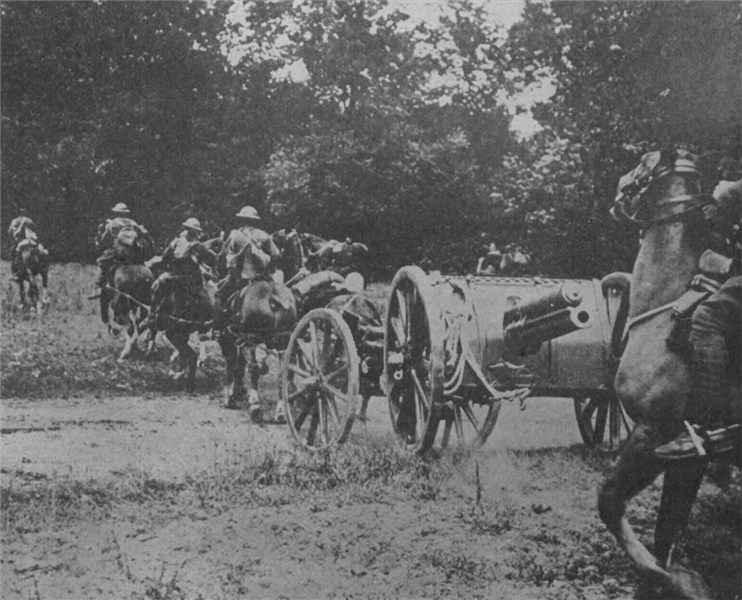
The soldiers are wearing bandoliers suggesting they are mounted and lanyards suggesting they are gunners and worn on the left shoulder suggesting before 1920 or whatever.
They are also probably wearing spurs, trousers of the riding variety and a Royal Artillery badge on their caps all of which are unfortunately out of the picture. Their faces have a “haven’t been to war yet” look about them.
My guess would be Royal Artillery, gunners and/or drivers. There’s some sort of identifying badge on their shoulder straps.
http://www.firstworldwar.com/photos/gra ... art_01.jpg
Hope this helps,
Alan
That’s a great picture. Could the postmark date be 7 October, 1916.
The soldiers are wearing bandoliers suggesting they are mounted and lanyards suggesting they are gunners and worn on the left shoulder suggesting before 1920 or whatever.
They are also probably wearing spurs, trousers of the riding variety and a Royal Artillery badge on their caps all of which are unfortunately out of the picture. Their faces have a “haven’t been to war yet” look about them.
My guess would be Royal Artillery, gunners and/or drivers. There’s some sort of identifying badge on their shoulder straps.
http://www.firstworldwar.com/photos/gra ... art_01.jpg
Hope this helps,
Alan
-
morgano
- Posts: 62
- Joined: Tue Aug 26, 2008 2:59 am
I agree with LesleyB on "Farnham" and "Twezeldown", although the place seems to have several spellings, the usual one today being Tweseldown. It's variously described as being in Farnborough, Fleet, Aldershot and Church Crookham (all in Hampshire, whereas Farnham is over the border in Surrey), but Farnham was certainly the name on the postmark. I have found a link to a WWI postcard, showing the camp and the postmark:
http://www.21stcenturyauctions.com.au/c ... kLot=00963
(If you click on the images, you get a reasonably visible version.) The front of the postcard (i.e. the one in this link) offers another way to spell "Twesledown". It seems as though all sorts passed through the camp: Scots, Aussies and Liverpudlians in 1916 alone. The fact that the photo was taken in Perth is probably a better clue to the regiment than the link to Tweseldown. I am no expert on WWI uniforms by a very long way, so I can't see anything in the photograph that might conclusively identify the unit, but I think that the 1903 style of bandolier may indicate a mounted formation (which could be artillery or engineers, as well as cavalry). Lanyards were traditionally a feature of artillery uniform, but turn up pretty frequently in other formations, including infantry. Note the pleated pockets and the patch covering the right shoulder. I think that the patch was meant to reinforce the tunic against the recoil of a Lee-Enfield rifle (which was used by all branches of the Army), while the pleats just looked nice. Both features vanished from the standard uniform, as the Great War dragged on.
Morgano
http://www.21stcenturyauctions.com.au/c ... kLot=00963
(If you click on the images, you get a reasonably visible version.) The front of the postcard (i.e. the one in this link) offers another way to spell "Twesledown". It seems as though all sorts passed through the camp: Scots, Aussies and Liverpudlians in 1916 alone. The fact that the photo was taken in Perth is probably a better clue to the regiment than the link to Tweseldown. I am no expert on WWI uniforms by a very long way, so I can't see anything in the photograph that might conclusively identify the unit, but I think that the 1903 style of bandolier may indicate a mounted formation (which could be artillery or engineers, as well as cavalry). Lanyards were traditionally a feature of artillery uniform, but turn up pretty frequently in other formations, including infantry. Note the pleated pockets and the patch covering the right shoulder. I think that the patch was meant to reinforce the tunic against the recoil of a Lee-Enfield rifle (which was used by all branches of the Army), while the pleats just looked nice. Both features vanished from the standard uniform, as the Great War dragged on.
Morgano