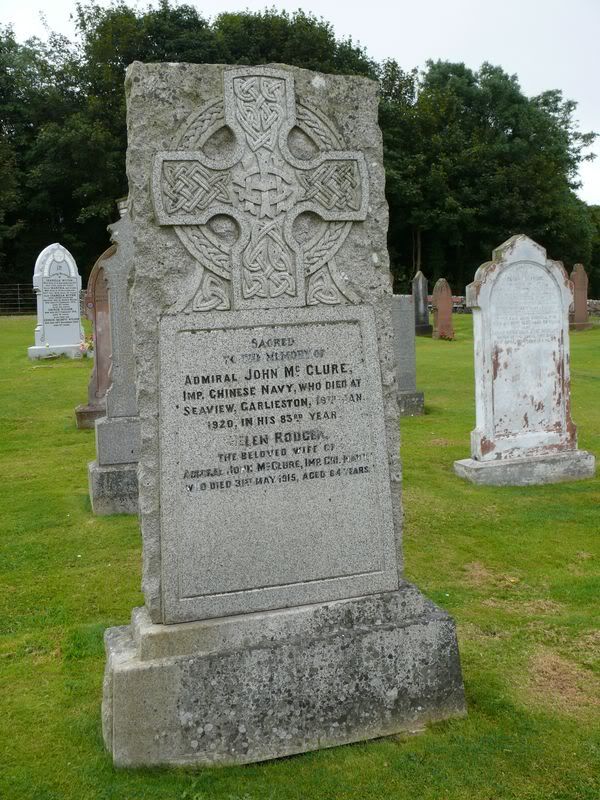
A grave in St Cuthbert's Cemetery in Kirkudbright contains this grave:
Admiral John McClure
Imp Chinese Navy
who died at Seaview, Garlieston
18 January 1920
in his 83rd year
It looks like he was in The Imperial Chinese Navy in 1895 when he was involved in the surrender of the naval base ay Wei-Hai-Wei after his Chinese commanders all committed suicide. It was left to McClure as a Vice-Admiral to tidy up the mess with Admiral Ito of the Imperial Japanese Navy.
Does anyone know about McClure before this time? I assume he was hired by the Chinese because of his experience in the Royal Navy.
He is described as a Scotchman in other sources so perhaps he didn't just retire to Garlieston but may have had a connection to there before he ran away to sea?
Any help in filling in some more detail about McClure before his surrender in 1895 and his death in 1920 would be apreciated.
Kind regards
Adam
Admiral John McClure of Garlieston and Chinese Navy!
Moderators: Global Moderators, Pandabean
-
Adam Brown
- Posts: 166
- Joined: Fri Jun 13, 2008 9:25 pm
- Location: Edinburgh
Admiral John McClure of Garlieston and Chinese Navy!
[url=http://warmemscot.s4.bizhat.com/]Scottish War Memorials[/url]
[url=http://scottishwargraves.phpbbweb.com/]Scottish War Graves[/url]
[url=http://scottishmonuments.s2.bizhat.com/]Scottish Monuments, Memorials and Architectural Sculpture[/url]
[url=http://scottishwargraves.phpbbweb.com/]Scottish War Graves[/url]
[url=http://scottishmonuments.s2.bizhat.com/]Scottish Monuments, Memorials and Architectural Sculpture[/url]
-
WilmaM
- Posts: 1920
- Joined: Fri Dec 17, 2004 10:46 am
- Location: Falkirk area
-
AndrewP
- Site Admin
- Posts: 6189
- Joined: Sun Dec 12, 2004 1:36 am
- Location: Edinburgh
Using the parents' names given on his death certificate leads to the OPR record for his birth in 1837 in Kirkcudbright. His second wife died in Kirkcudbright. His second marriage in 1897 was not in south-west Scotland, but they both gave their home addresses as Garliestown. There is no obvious sign of the marriage or death details of his first wife in Scotland.
The death certificates for his parents show that both died at Garliestown.
All the best,
AndrewP
The death certificates for his parents show that both died at Garliestown.
All the best,
AndrewP
-
Adam Brown
- Posts: 166
- Joined: Fri Jun 13, 2008 9:25 pm
- Location: Edinburgh
AndrewP
That's brilliant information. I wasn't sure if he had retired to the area but this information shows he was from the South-West originally.
I suppose a search through the Navy lists from the 1850s should show if he was in the Royal Navy as a young man.
Thanks for looking.
Here's the headstone by the way. It gives the second wife's name and date of death. Helen Rodger died 31st May 1915.
Regards
Adam
That's brilliant information. I wasn't sure if he had retired to the area but this information shows he was from the South-West originally.
I suppose a search through the Navy lists from the 1850s should show if he was in the Royal Navy as a young man.
Thanks for looking.
Here's the headstone by the way. It gives the second wife's name and date of death. Helen Rodger died 31st May 1915.
Regards
Adam
[url=http://warmemscot.s4.bizhat.com/]Scottish War Memorials[/url]
[url=http://scottishwargraves.phpbbweb.com/]Scottish War Graves[/url]
[url=http://scottishmonuments.s2.bizhat.com/]Scottish Monuments, Memorials and Architectural Sculpture[/url]
[url=http://scottishwargraves.phpbbweb.com/]Scottish War Graves[/url]
[url=http://scottishmonuments.s2.bizhat.com/]Scottish Monuments, Memorials and Architectural Sculpture[/url]
-
Currie
- Posts: 3924
- Joined: Fri Jun 22, 2007 3:20 am
- Location: Australia
Hello Adam,
It’s looking as though Vice-Admiral McClure was just an ordinary captain in the Merchant Marine. But then the Chinese Navy wasn’t much of one.
Aberdeen Weekly Journal (Aberdeen), Thursday, November 22, 1894
THE WAR IN THE EAST.
Shanghai, Wednesday.—Captain M’Clure, of the British merchant service, who has been appointed vice-admiral of the Chinese fleet by the Tsungli Yamen (?), has arrived at Wei-Hai-Wei, and joined his command. According to the latest news the Chinese squadron were still etc. ………………
THE NEW VICE-ADMIRAL OF THE CHINESE FLEET.
Captain M’Clure, who has been appointed Vice-Admiral of the Chinese Fleet, is a son of the late Mr. John M’Clure, architect on Lord Galloway’s estates in Wigtonshire. Captain M’Clure, who is in the prime of life, has had long and intimate acquaintance with the Chinese coasts. He was for many years employed as a captain by Messrs. Jardine, Mattheson, and Company, and took out from Barrow and sailed for two or three years the Howsching. When hostilities commenced the Chinese authorities sought the services of Captain M’Clure for transport and despatch work. He has long possessed the confidence of many leading men in China, and to his friends in Scotland his appointment to the new position is accepted as an indication that stirring events may be anticipated in connection with the movements of the Chinese and Japanese Fleets.
Other newspapers of the time published similar reports but give the ship’s name correctly as Kow Shing. I couldn’t see much in the Times just a mention on Saturday, Nov 17, 1894, that Captain M’Clure had been appointed Assistant Admiral of the Pei-Yang squadron.
The Kow Shing, Official Number: 87100, while flying a British ensign, was sunk in 1894 by the Japanese with great loss of life of its passengers who were Chinese troops being transported to a war zone. It looks as though McClure may have had a financial interest in the vessel as a Miss McClure launched it in 1883. The ship was owned by the Indo-China Steam Navigation Co. http://www.barrowbuiltships.co.uk/page124a.html
There’s a few words about McClure here http://www.archive.org/stream/casesonin ... g_djvu.txt
But if Cameron should be punished why was the Chinese vice-admiral McClure allowed to go free? He was on board the Ching-longy a steamer which had served as a military despatch boat, and when that vessel was searched at Port Arthur he protested his neutrality in the war, while he was actually engaged in the most important hostilities. In fact McClure deceived the Japanese navy, but he was released in accordance with the provisions of the convention.
If you want the newspaper image just send me a PM with an email address.
All the best,
Alan
It’s looking as though Vice-Admiral McClure was just an ordinary captain in the Merchant Marine. But then the Chinese Navy wasn’t much of one.
Aberdeen Weekly Journal (Aberdeen), Thursday, November 22, 1894
THE WAR IN THE EAST.
Shanghai, Wednesday.—Captain M’Clure, of the British merchant service, who has been appointed vice-admiral of the Chinese fleet by the Tsungli Yamen (?), has arrived at Wei-Hai-Wei, and joined his command. According to the latest news the Chinese squadron were still etc. ………………
THE NEW VICE-ADMIRAL OF THE CHINESE FLEET.
Captain M’Clure, who has been appointed Vice-Admiral of the Chinese Fleet, is a son of the late Mr. John M’Clure, architect on Lord Galloway’s estates in Wigtonshire. Captain M’Clure, who is in the prime of life, has had long and intimate acquaintance with the Chinese coasts. He was for many years employed as a captain by Messrs. Jardine, Mattheson, and Company, and took out from Barrow and sailed for two or three years the Howsching. When hostilities commenced the Chinese authorities sought the services of Captain M’Clure for transport and despatch work. He has long possessed the confidence of many leading men in China, and to his friends in Scotland his appointment to the new position is accepted as an indication that stirring events may be anticipated in connection with the movements of the Chinese and Japanese Fleets.
Other newspapers of the time published similar reports but give the ship’s name correctly as Kow Shing. I couldn’t see much in the Times just a mention on Saturday, Nov 17, 1894, that Captain M’Clure had been appointed Assistant Admiral of the Pei-Yang squadron.
The Kow Shing, Official Number: 87100, while flying a British ensign, was sunk in 1894 by the Japanese with great loss of life of its passengers who were Chinese troops being transported to a war zone. It looks as though McClure may have had a financial interest in the vessel as a Miss McClure launched it in 1883. The ship was owned by the Indo-China Steam Navigation Co. http://www.barrowbuiltships.co.uk/page124a.html
There’s a few words about McClure here http://www.archive.org/stream/casesonin ... g_djvu.txt
But if Cameron should be punished why was the Chinese vice-admiral McClure allowed to go free? He was on board the Ching-longy a steamer which had served as a military despatch boat, and when that vessel was searched at Port Arthur he protested his neutrality in the war, while he was actually engaged in the most important hostilities. In fact McClure deceived the Japanese navy, but he was released in accordance with the provisions of the convention.
If you want the newspaper image just send me a PM with an email address.
All the best,
Alan
-
Adam Brown
- Posts: 166
- Joined: Fri Jun 13, 2008 9:25 pm
- Location: Edinburgh
Alan
That's some great information and it has saved me a trawl through the Navy Lists!
Many thanks for the help. I’ve also been given the name of a contact in the Stewartry Museum who may have more information about McClure. If I find anything more I'll post it here.
Kind regards
Adam
That's some great information and it has saved me a trawl through the Navy Lists!
Many thanks for the help. I’ve also been given the name of a contact in the Stewartry Museum who may have more information about McClure. If I find anything more I'll post it here.
Kind regards
Adam
[url=http://warmemscot.s4.bizhat.com/]Scottish War Memorials[/url]
[url=http://scottishwargraves.phpbbweb.com/]Scottish War Graves[/url]
[url=http://scottishmonuments.s2.bizhat.com/]Scottish Monuments, Memorials and Architectural Sculpture[/url]
[url=http://scottishwargraves.phpbbweb.com/]Scottish War Graves[/url]
[url=http://scottishmonuments.s2.bizhat.com/]Scottish Monuments, Memorials and Architectural Sculpture[/url]
-
Currie
- Posts: 3924
- Joined: Fri Jun 22, 2007 3:20 am
- Location: Australia
Back again Adam,
I went looking for something about the Architect but only found some more about the Admiral. I OCR’d these so there may be some errors I missed.
A couple of paragraphs from an article in The Derby Mercury (Derby), Wednesday, November 28, 1894.
CHINA AND JAPAN.
BRITISH COMMANDER FOR THE CHINESE FLEET.
Perhaps the most interesting announcement in Wednesday's telegrams, next to the withdrawal of President Cleveland's offer of intervention, is that a British merchant skipper—Captain McClure—has been appointed a Chinese Vice-Admiral, and has joined the squadron at Wei-hai Wei. Whether he is to supersede or nominally assist Admiral Ting is not stated, but there is little doubt that on him will devolve the practical command of the Fleet. It will be interesting to see whether the Chinese squadron, handled by a sailor, will be capable of a bettor performance than that off the Yalu River. In all probability, Captain—or Admiral—McClure has with him the two ironclads Ting Yuen and Chen Yuen, which are much better protected than any of the ships in the Japanese fleet, and which on Sept. 17 kept up a prolonged combat with five or six of the finest Japanese cruisers, with great loss to themselves certainly, but without fatal damage. These are supported by several cruisers of fairly modern type, and the whole fleet has, according to Chinese reports, been strengthened by the addition of quick-firing guns to their armaments.
Captain M'Clure, who is announced to have been appointed Vice Admiral of the Chinese Fleet, is a native of the South of Scotland, being a son of the late Mr. M'Clure Long, architect to the Earl of Galloway. Captain M’Clure possesses an intimate knowledge of the China seas, having for many years commanded vessels belonging to Messrs. Jardine, Matheson, and Co. He took out the Kow Shing from Barrow, and commanded that vessel for several years. Latterly he has had an important position with the Taku Tug and Lighter Company. A few months ago he was requested by the Chinese authorities to accept command of a despatch boat. His services in that capacity have so far commended him that he has received the important appointment of Vice-Admiral.
This is the full article from The Pall Mall Gazette (London), Monday, April 29, 1895.
EUROPEAN OFFICERS WITH THE CHINESE
(FROM OUR OWN CORRESPONDENT.)
HIROSHIMA, March 12.—Exactly a month has elapsed since I viewed the white flag which sheltered the offer of capitulation sent by China's last and only admiral to his Japanese besiegers at Wai-Hei-Wai, and at length I am able to tell the story of the struggle from the point of view of the vanquished. My apology for the delay is that the vanquished were smuggled away to Chefoo without our being able to get at them, and but for Admiral Fremantle’s courtesy they would still have been inaccessible so far as we on the Japanese side are concerned. In the main their story is extremely creditable, so far as the European defenders are concerned, although it is a record of failure. For it shows that British pluck alone sustained the conflict for fourteen cold, hungry, harassing days and nights, and that it was British skill which trained the guns with an accuracy fatal to so many of Ito's ships and men. The German employees in China's naval service deserted her in her hour of need, almost to a man—a point to which Ting often and bitterly referred. After the Yellow Sea engagement, in August last, the Chinese fleet sought shelter at Wai-Hei-Wai most of the time, the last occasion when it put to sea being just about the date when Port Arthur fell, in November. There were at that time some two dozen Europeans engaged on the ships and the land defences of the port, seven or eight of them being German torpedo and gunnery instructors, and a somewhat larger number of men trained in the British navy, either as officers or bluejackets. When the intentions of the Japanese to land in Shantung became apparent, towards the middle of January, the German contingent, consisting of Messrs. Fleischer, Albrecht, Heckmann, Plumbach, Neilsen, Basse, and Schnell, started for Chefoo like one man. They were followed a little later, just before the Japanese investment began, by Commander Squire (a retired British naval officer); Mr. McGiffen (the American engineer who distinguished himself in the Yalu battle); Mr. Nelson, an Englishman attached to the Chinese Intelligence Department, and therefore a non-combatant; Lieutenant Bourchier, R.N.; Captain Calder, the harbour master; Mr. Kingsley, Customs harbour master; and a naval inspector named Jackman. Commander Squire, it should be stated, was for
SOME YEARS IN THE JAPANESE NAVAL SERVICE,
and after leaving it, shortly before the war broke out, joined the Chinese. He held no particular appointment, however, and did not seem to be particularly prominent. Lieutenant Bourchier was a British officer whose services had been lent to the Chinese, and he was compelled to withdraw, being ordered to do so by Admiral Fremantle. Jackman and Kingsley, like McGiffen, had already given proofs of their courage, having both fought on the Chinese side in the Franco-Chinese war ten years ago—indeed Kingsley's organization of the defences at Chin-hei, near Ningpo, effectually scared that particular enemy away and won Kingsley a decoration. Apart from this, their years of service in the dangerous duty of repressing smuggling and piracy in various parts of China showed that their defection was mainly due to nothing but respect for the terrors of the Foreign Enlistment Act. On reaching Chefoo most of the deserters met with the sort of reception which such men might expect. One of the Germans—Schnell—had the grace to return to his post, a day or two before the attack on the southern gate of the Pechili Gulf was opened. He fought both hard and skilfully, it is true, but in the end he led the chorus in the clamour for surrender, and gave up the guns his employer at Essen had sold to the Chinese. It was no easy matter to gather a full and detailed account of the exciting experiences during the fortnight's fighting from those who had taken part in it. Chefoo—the Little Brighton of the Europeans in North China—was already in a chaotic state when, by the magnanimity of Admiral Ito, they arrived there on the 17th ult., and when they were interviewed a few days later matters were even worse. The tiny foreign settlement was in daily danger from the encampments of undisciplined Chinese soldiery two or three miles away; such trade as used to exist was at a standstill; and the ex-prisoners, compelled to inactivity until the break-up of the ice around Tientsin a fortnight or three weeks later permitted them to go to Li Hung Chang and
DEMAND THEIR ARREARS OF PAY,
were difficult to get hold of, and not always very communicative even when cornered. Their reticence was not unnatural. By some selfish statute or other—originally passed for the benefit of monopolists like the East India, Hudson's Bay, and similar companies—most Europeans abroad are even yet liable to severe punishment by their Governments if they take up arms either for or against the Power that employs them. Admiral McClure was naturally the interviewer's first victim. He was tall and bony, and carried his half-century lightly, despite the many years spent in navigating Chinese waters. His thorough knowledge of the coast, and friendship with Von Hanneken and Detring, Li Hung Chang’s German counsellors, led to his being invited to leave the Tientsin and Taku Tug and Lighter Company last autumn, and step straightaway into an admiral's uniform, with a pay of £150 or so monthly. He was naturally associated with Ting, but what share he bore in the fighting he could not be induced to say, and the other Europeans did not seem to know. It could not have been a very prominent part, anyway, for McClure's forte was navigation, not fighting, and there was very little needed in that way after the fleet shut itself up in Wai-Hei-Wai waters. Colonel Th. Schnell, who ranked next in the foreign corps, was a man of about the same age, and was a tall, military-looking individual. Originally an Unteroffizier in the German army, he joined the Chinese service twenty-seven years ago as infantry instructor, combining with those functions, later, that of Krupp's agent. Not that he admitted this—on the contrary, he denied any relation with Essen, but his designation on the printed envelopes which I had seen in his quarters at Liu-kan put the matter beyond doubt. Of his desertion from the service
WHEN THE CRISIS THREATENED
I have already spoken; regarding the valuable services he rendered after his return there was a consensus of testimony. The forts on the island, he mentioned, had all been built within the last ten years, some during the last few months, even, and others, as I had seen, were still is course of construction. The design had been to render Liu-kan impregnable, either from land or sea, but latterly it had been decided to extend the defences on the mainland, where, originally, only two forts were constructed. He had nothing to do with the work or science of artillery, he said; but that he possessed a sound knowledge of gunnery was clear from the accuracy of the fire where he directed it. Most of the time, alter the bombardment began, he had charge of the eastern island forts, which Ito's ships, aided by the forts across the channel, strove vainly to silence. As I mentioned in my last letter, giving a description of the island, only a very small percentage of the thousands of projectiles which were hurled against them during successive days inflicted any damage, whereas the Chinese fire came very near disabling fully half a dozen Japanese vessels—not to speak of the Centurion's close shaves— and dismounted two or three of the heavy guns on the mainland. On the morning of the 10th, in reply to Schnell's inquiry "Where shall I aim now?" the Chinese flagship signalled that Ting was away, and that ammunition must be reserved in case of an attack by the Japanese fleet. Schnell was very indignant with Ting for not allowing him to continue pounding away at the Japanese forts across the water, which, as was plainly discernible, were being badly damaged, and must be evacuated before long. That was probably the cause of his reiterated recommendations to surrender— advice openly given, on the grounds that to prolong the resistance would only exasperate the enemy, and perhaps cost them all their lives. The leaven of cowardice soon spread—chiefly among the native officers at first, and later permeating the rank and file. Ting strove against the tide, even to ordering his men to fire on a body of mutinous soldiers who were advancing towards his yamen; but in the end he had to give way, much to the disgust of the majority of the foreigners, some of whom—Howie, for example—felt that surrender would inevitably be the prelude to execution. Schnell did not hand Ting the opium, nor did he hand over China's fleet and fortress to the Japanese; but in my opinion he was morally responsible for both calamities—or, at least, for hastening them.
In the first article the section "son of the late Mr. M'Clure Long, architect" is exactly how it appears in the newspaper" A printing error I suppose.
Hope that’s interesting,
Alan
I went looking for something about the Architect but only found some more about the Admiral. I OCR’d these so there may be some errors I missed.
A couple of paragraphs from an article in The Derby Mercury (Derby), Wednesday, November 28, 1894.
CHINA AND JAPAN.
BRITISH COMMANDER FOR THE CHINESE FLEET.
Perhaps the most interesting announcement in Wednesday's telegrams, next to the withdrawal of President Cleveland's offer of intervention, is that a British merchant skipper—Captain McClure—has been appointed a Chinese Vice-Admiral, and has joined the squadron at Wei-hai Wei. Whether he is to supersede or nominally assist Admiral Ting is not stated, but there is little doubt that on him will devolve the practical command of the Fleet. It will be interesting to see whether the Chinese squadron, handled by a sailor, will be capable of a bettor performance than that off the Yalu River. In all probability, Captain—or Admiral—McClure has with him the two ironclads Ting Yuen and Chen Yuen, which are much better protected than any of the ships in the Japanese fleet, and which on Sept. 17 kept up a prolonged combat with five or six of the finest Japanese cruisers, with great loss to themselves certainly, but without fatal damage. These are supported by several cruisers of fairly modern type, and the whole fleet has, according to Chinese reports, been strengthened by the addition of quick-firing guns to their armaments.
Captain M'Clure, who is announced to have been appointed Vice Admiral of the Chinese Fleet, is a native of the South of Scotland, being a son of the late Mr. M'Clure Long, architect to the Earl of Galloway. Captain M’Clure possesses an intimate knowledge of the China seas, having for many years commanded vessels belonging to Messrs. Jardine, Matheson, and Co. He took out the Kow Shing from Barrow, and commanded that vessel for several years. Latterly he has had an important position with the Taku Tug and Lighter Company. A few months ago he was requested by the Chinese authorities to accept command of a despatch boat. His services in that capacity have so far commended him that he has received the important appointment of Vice-Admiral.
This is the full article from The Pall Mall Gazette (London), Monday, April 29, 1895.
EUROPEAN OFFICERS WITH THE CHINESE
(FROM OUR OWN CORRESPONDENT.)
HIROSHIMA, March 12.—Exactly a month has elapsed since I viewed the white flag which sheltered the offer of capitulation sent by China's last and only admiral to his Japanese besiegers at Wai-Hei-Wai, and at length I am able to tell the story of the struggle from the point of view of the vanquished. My apology for the delay is that the vanquished were smuggled away to Chefoo without our being able to get at them, and but for Admiral Fremantle’s courtesy they would still have been inaccessible so far as we on the Japanese side are concerned. In the main their story is extremely creditable, so far as the European defenders are concerned, although it is a record of failure. For it shows that British pluck alone sustained the conflict for fourteen cold, hungry, harassing days and nights, and that it was British skill which trained the guns with an accuracy fatal to so many of Ito's ships and men. The German employees in China's naval service deserted her in her hour of need, almost to a man—a point to which Ting often and bitterly referred. After the Yellow Sea engagement, in August last, the Chinese fleet sought shelter at Wai-Hei-Wai most of the time, the last occasion when it put to sea being just about the date when Port Arthur fell, in November. There were at that time some two dozen Europeans engaged on the ships and the land defences of the port, seven or eight of them being German torpedo and gunnery instructors, and a somewhat larger number of men trained in the British navy, either as officers or bluejackets. When the intentions of the Japanese to land in Shantung became apparent, towards the middle of January, the German contingent, consisting of Messrs. Fleischer, Albrecht, Heckmann, Plumbach, Neilsen, Basse, and Schnell, started for Chefoo like one man. They were followed a little later, just before the Japanese investment began, by Commander Squire (a retired British naval officer); Mr. McGiffen (the American engineer who distinguished himself in the Yalu battle); Mr. Nelson, an Englishman attached to the Chinese Intelligence Department, and therefore a non-combatant; Lieutenant Bourchier, R.N.; Captain Calder, the harbour master; Mr. Kingsley, Customs harbour master; and a naval inspector named Jackman. Commander Squire, it should be stated, was for
SOME YEARS IN THE JAPANESE NAVAL SERVICE,
and after leaving it, shortly before the war broke out, joined the Chinese. He held no particular appointment, however, and did not seem to be particularly prominent. Lieutenant Bourchier was a British officer whose services had been lent to the Chinese, and he was compelled to withdraw, being ordered to do so by Admiral Fremantle. Jackman and Kingsley, like McGiffen, had already given proofs of their courage, having both fought on the Chinese side in the Franco-Chinese war ten years ago—indeed Kingsley's organization of the defences at Chin-hei, near Ningpo, effectually scared that particular enemy away and won Kingsley a decoration. Apart from this, their years of service in the dangerous duty of repressing smuggling and piracy in various parts of China showed that their defection was mainly due to nothing but respect for the terrors of the Foreign Enlistment Act. On reaching Chefoo most of the deserters met with the sort of reception which such men might expect. One of the Germans—Schnell—had the grace to return to his post, a day or two before the attack on the southern gate of the Pechili Gulf was opened. He fought both hard and skilfully, it is true, but in the end he led the chorus in the clamour for surrender, and gave up the guns his employer at Essen had sold to the Chinese. It was no easy matter to gather a full and detailed account of the exciting experiences during the fortnight's fighting from those who had taken part in it. Chefoo—the Little Brighton of the Europeans in North China—was already in a chaotic state when, by the magnanimity of Admiral Ito, they arrived there on the 17th ult., and when they were interviewed a few days later matters were even worse. The tiny foreign settlement was in daily danger from the encampments of undisciplined Chinese soldiery two or three miles away; such trade as used to exist was at a standstill; and the ex-prisoners, compelled to inactivity until the break-up of the ice around Tientsin a fortnight or three weeks later permitted them to go to Li Hung Chang and
DEMAND THEIR ARREARS OF PAY,
were difficult to get hold of, and not always very communicative even when cornered. Their reticence was not unnatural. By some selfish statute or other—originally passed for the benefit of monopolists like the East India, Hudson's Bay, and similar companies—most Europeans abroad are even yet liable to severe punishment by their Governments if they take up arms either for or against the Power that employs them. Admiral McClure was naturally the interviewer's first victim. He was tall and bony, and carried his half-century lightly, despite the many years spent in navigating Chinese waters. His thorough knowledge of the coast, and friendship with Von Hanneken and Detring, Li Hung Chang’s German counsellors, led to his being invited to leave the Tientsin and Taku Tug and Lighter Company last autumn, and step straightaway into an admiral's uniform, with a pay of £150 or so monthly. He was naturally associated with Ting, but what share he bore in the fighting he could not be induced to say, and the other Europeans did not seem to know. It could not have been a very prominent part, anyway, for McClure's forte was navigation, not fighting, and there was very little needed in that way after the fleet shut itself up in Wai-Hei-Wai waters. Colonel Th. Schnell, who ranked next in the foreign corps, was a man of about the same age, and was a tall, military-looking individual. Originally an Unteroffizier in the German army, he joined the Chinese service twenty-seven years ago as infantry instructor, combining with those functions, later, that of Krupp's agent. Not that he admitted this—on the contrary, he denied any relation with Essen, but his designation on the printed envelopes which I had seen in his quarters at Liu-kan put the matter beyond doubt. Of his desertion from the service
WHEN THE CRISIS THREATENED
I have already spoken; regarding the valuable services he rendered after his return there was a consensus of testimony. The forts on the island, he mentioned, had all been built within the last ten years, some during the last few months, even, and others, as I had seen, were still is course of construction. The design had been to render Liu-kan impregnable, either from land or sea, but latterly it had been decided to extend the defences on the mainland, where, originally, only two forts were constructed. He had nothing to do with the work or science of artillery, he said; but that he possessed a sound knowledge of gunnery was clear from the accuracy of the fire where he directed it. Most of the time, alter the bombardment began, he had charge of the eastern island forts, which Ito's ships, aided by the forts across the channel, strove vainly to silence. As I mentioned in my last letter, giving a description of the island, only a very small percentage of the thousands of projectiles which were hurled against them during successive days inflicted any damage, whereas the Chinese fire came very near disabling fully half a dozen Japanese vessels—not to speak of the Centurion's close shaves— and dismounted two or three of the heavy guns on the mainland. On the morning of the 10th, in reply to Schnell's inquiry "Where shall I aim now?" the Chinese flagship signalled that Ting was away, and that ammunition must be reserved in case of an attack by the Japanese fleet. Schnell was very indignant with Ting for not allowing him to continue pounding away at the Japanese forts across the water, which, as was plainly discernible, were being badly damaged, and must be evacuated before long. That was probably the cause of his reiterated recommendations to surrender— advice openly given, on the grounds that to prolong the resistance would only exasperate the enemy, and perhaps cost them all their lives. The leaven of cowardice soon spread—chiefly among the native officers at first, and later permeating the rank and file. Ting strove against the tide, even to ordering his men to fire on a body of mutinous soldiers who were advancing towards his yamen; but in the end he had to give way, much to the disgust of the majority of the foreigners, some of whom—Howie, for example—felt that surrender would inevitably be the prelude to execution. Schnell did not hand Ting the opium, nor did he hand over China's fleet and fortress to the Japanese; but in my opinion he was morally responsible for both calamities—or, at least, for hastening them.
In the first article the section "son of the late Mr. M'Clure Long, architect" is exactly how it appears in the newspaper" A printing error I suppose.
Hope that’s interesting,
Alan
-
Adam Brown
- Posts: 166
- Joined: Fri Jun 13, 2008 9:25 pm
- Location: Edinburgh
Alan
That is very interesting, many thanks for delving deeper. I new nothing about this conflict before last week but the more you dig up the more interesting it becomes.
I have created a page on Wikipedia about John McClure since he didn't get a mention at all in their pages about Wei-Hai-Wei and Admiral Ting so any extra infomation is gratefully received.
Thanks again
Adam
That is very interesting, many thanks for delving deeper. I new nothing about this conflict before last week but the more you dig up the more interesting it becomes.
I have created a page on Wikipedia about John McClure since he didn't get a mention at all in their pages about Wei-Hai-Wei and Admiral Ting so any extra infomation is gratefully received.
Thanks again
Adam
[url=http://warmemscot.s4.bizhat.com/]Scottish War Memorials[/url]
[url=http://scottishwargraves.phpbbweb.com/]Scottish War Graves[/url]
[url=http://scottishmonuments.s2.bizhat.com/]Scottish Monuments, Memorials and Architectural Sculpture[/url]
[url=http://scottishwargraves.phpbbweb.com/]Scottish War Graves[/url]
[url=http://scottishmonuments.s2.bizhat.com/]Scottish Monuments, Memorials and Architectural Sculpture[/url]